


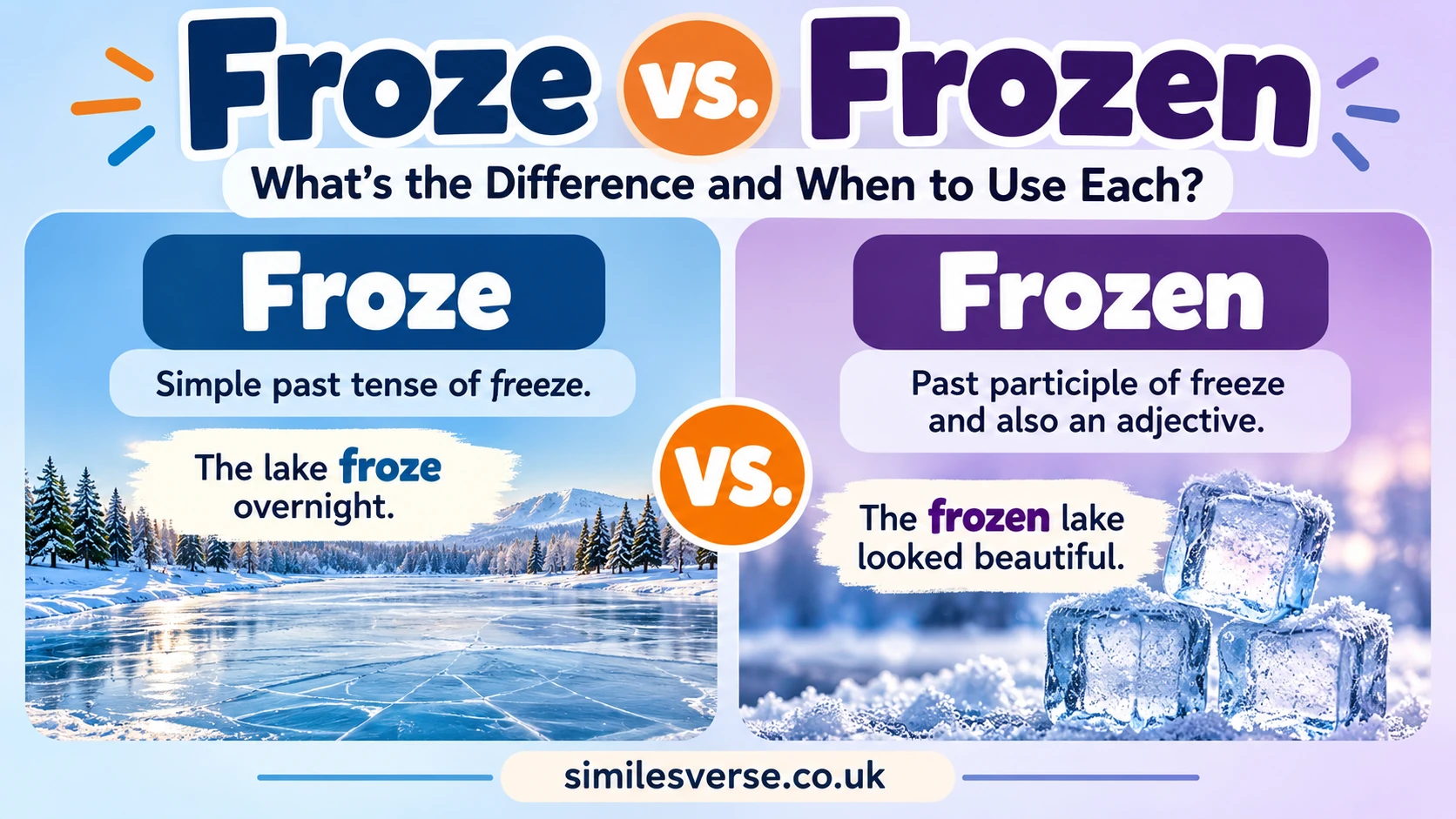
Froze is the simple past tense of freeze, while frozen is its past participle. Frozen can also function as an adjective describing something that has become solid, extremely cold, or unable to move.
Consider these three sentences:
- The fountain froze overnight. — Simple past tense.
- The fountain has frozen. — Present perfect tense.
- The frozen fountain looked beautiful. — Adjective describing the fountain.
All three sentences are grammatically correct. The difference is how each word functions in the sentence.
The easiest way to remember the forms is freeze → froze → frozen.
Freeze, Froze, and Frozen: Verb Forms
Freeze is an irregular verb. Unlike regular verbs that typically add -ed to form the past tense, freeze changes its spelling.
| Verb Form | Correct Word | Example Sentence |
|---|---|---|
| Base form | Freeze | I freeze extra bread to keep it fresh. |
| Third-person singular present | Freezes | The creek freezes during severe winters. |
| Present participle | Freezing | The water is freezing around the edges. |
| Simple past | Froze | The creek froze during the cold snap. |
| Past participle | Frozen | The creek has frozen again. |
The three principal forms are freeze, froze, and frozen. However, freezes and freezing are also essential when using the verb in everyday English.
When to Use Froze
Use froze when freeze is the main verb in the simple past tense.
It describes something that happened in the past, such as water becoming ice, a device suddenly stopping, or a person becoming motionless.
Examples:
- The water in the birdbath froze overnight.
- My computer froze while I was editing a document.
- The child froze when the dog barked.
- I froze the leftover soup after dinner.
- The company froze hiring during the budget review.
In each example, froze expresses a past occurrence.
Does Froze Always Mean the Situation Is Over?
No. The simple past places an event in the past, but its consequences may continue.
For example:
The bank froze the account yesterday.
The decision happened yesterday, but the account may still be restricted today.
Similarly, if your computer froze five minutes ago, it might still be unresponsive.
The simple past does not automatically tell us whether the resulting condition has ended.
Using Froze in Questions and Negative Sentences
When did or didn’t forms a simple-past question or negative statement, use the base form freeze, not froze.
- Correct: Did the river freeze last night?
- Incorrect: Did the river froze last night?
- Correct: The river didn’t freeze.
- Incorrect: The river didn’t froze.
The auxiliary did already carries the past-tense marking.
When to Use Frozen
Frozen is the past participle of freeze. It appears in perfect verb constructions, can be used in passive constructions, and frequently functions as an adjective.
1. Frozen as a Past Participle
In perfect constructions, frozen follows the appropriate form of have.
Examples:
- The pipes have frozen again.
- The fruit has frozen completely.
- We had frozen the leftovers before leaving.
- By morning, the shallow pond will have frozen if the temperature stays low enough.
Here, frozen is part of a verb phrase.
2. Frozen in Passive Constructions
The past participle also appears when something receives the action of freezing.
The laboratory samples were frozen by the technician.
The technician performed the action, while the samples received it.
Other examples include:
- The desserts were frozen before delivery.
- The fish will be frozen immediately after processing.
Passive constructions commonly use a form of be followed by a past participle.
3. Frozen as an Adjective
Frozen can describe a noun without functioning as the main verb.
Examples:
- We bought frozen strawberries.
- The frozen ground made digging difficult.
- A frozen loading screen prevented us from continuing.
- The frozen lock would not turn.
In these sentences, frozen describes a condition or characteristic.
This is why frozen does not always require a helping verb.
Froze vs. Frozen: Side-by-Side Comparison
| Situation | Froze Example | Frozen Example | Explanation |
|---|---|---|---|
| Weather | The fountain froze overnight. | The fountain has frozen again. | Simple past versus present perfect |
| Food | The sauce froze in the garage. | The frozen sauce needs thawing. | Past event versus adjective |
| Computers | My tablet froze during the meeting. | My tablet has frozen twice today. | Simple past versus present perfect |
| Human reactions | Daniel froze when he heard the alarm. | Daniel stood frozen with surprise. | Past action versus condition |
| Frozen objects | The lock froze during the storm. | The frozen lock would not open. | Past event versus adjective |
| Physical conditions | Water in the hose froze overnight. | The hose is frozen solid. | Past event versus current condition |
The correct choice depends on the grammar of the sentence, not simply on whether you are discussing an action or a result.
Froze and Frozen in Perfect Tenses
Perfect constructions use frozen, not froze, as the past participle.
Present Perfect: Has or Have Frozen
Structure: Subject + has/have + frozen
Use the present perfect when a past event is relevant to the present or occurs within a period that continues up to now.
Examples:
- My laptop has frozen twice since lunch.
- The pipes have frozen again this winter.
- She has frozen several portions of homemade soup.
The first sentence discusses problems that occurred during a period continuing up to the present.
The second describes repeated incidents during the current winter.
The third describes completed freezing within a present-relevant context.
Correct: The screen has frozen.
Incorrect in standard American English: The screen has froze.
Past Perfect: Had Frozen
Structure: Subject + had + frozen
The past perfect can show that freezing happened before another past event.
Example:
The broth had frozen before the cook checked the freezer.
The sequence is:
- The broth froze.
- The cook checked the freezer.
Another example:
By the time the repair crew arrived, the outdoor pipes had frozen.
The freezing occurred before the crew’s arrival.
Future Perfect: Will Have Frozen
Structure: Subject + will have + frozen
The future perfect describes something expected to be completed by a particular future time.
Example:
If the cold weather continues, the shallow pond will have frozen by sunrise.
This means the freezing is expected to be complete by sunrise, assuming the stated condition holds.
Another example:
By the time the shipment leaves tomorrow, the prepared meals will have been frozen.
The second sentence uses the future perfect passive structure, will have been frozen.
Does Every Helping Verb Require Frozen?
No. This is an important distinction.
Different helping verbs require different forms of the main verb.
| Grammar Structure | Correct Example | Explanation |
|---|---|---|
| Has/have + past participle | The pond has frozen. | Present perfect |
| Had + past participle | The pond had frozen. | Past perfect |
| Will + base verb | The pond will freeze. | Future construction |
| Be + -ing form | The pond is freezing. | Progressive construction |
| Be + past participle | The samples were frozen by the technician. | Passive construction |
| Be + adjective | The lake is frozen. | Describes a condition |
| Did + base verb | Did the pond freeze? | Simple-past question |
Notice the differences:
- Has frozen is correct because the perfect construction requires a past participle.
- Will freeze is correct because will takes the base verb.
- Is freezing is correct because the progressive construction uses an -ing form.
- Is frozen is correct when describing a frozen condition.
Also compare these sentences:
She has frozen the peaches.
Here, has helps form the present perfect.
She has to freeze the peaches.
Here, has to expresses necessity and is followed by the base verb freeze.
The surrounding grammatical construction determines which form is correct.
Was Froze or Was Frozen: Which Is Correct?
In standard American English, was frozen is correct when using the past participle or adjective.
Examples:
- The water was frozen when we arrived.
- The meat was frozen before transportation.
- The gate was frozen shut.
Was froze is not the standard construction for these meanings.
However, was frozen can serve different functions depending on the context.
Was Frozen in Passive Voice
The vegetables were frozen by the processing company.
This describes an action performed on the vegetables.
You can identify the person or organization performing the action: the processing company.
Was Frozen as an Adjective
The lake was frozen when we arrived.
Here, the sentence describes the lake’s condition at a particular time.
It does not focus on someone performing an action.
Both constructions use frozen, but the first emphasizes an event performed on something, while the second describes a state.
The presence of was or were alone does not establish passive voice.
18 Everyday Examples of Froze and Frozen
These examples cover weather, food, technology, emotions, and professional situations.
Weather and Nature
1. The waterfall froze around its edges after several bitterly cold nights.
Froze describes what happened in the past.
2. The garden soil has frozen solid after three cold nights.
Has frozen uses the present perfect.
3. We waited for the frozen puddles to melt before riding our bikes.
Frozen describes the puddles.
Food and Cooking
4. I froze the leftover chili in individual containers.
Froze is the simple past of an action performed by the speaker.
5. We had frozen the peaches before they became overripe.
Had frozen places the freezing before another past situation.
6. The frozen dough needs another hour to thaw.
Frozen functions as an adjective modifying dough.
Computers and Technology
7. My editing program froze while I was exporting a video.
Froze describes a past software malfunction.
8. The payment terminal has frozen twice this morning.
Has frozen describes repeated problems during a time period that includes the present.
9. A frozen loading screen prevented us from completing the order.
Frozen describes the unresponsive screen.
Fear and Human Reactions
10. Maya froze when she heard a crash in the hallway.
Froze means Maya suddenly stopped moving.
11. The hikers stood frozen with fear as branches cracked overhead.
Frozen describes their motionless condition.
12. His smile froze when he noticed the unexpected visitor.
Froze expresses a sudden change in facial expression.
Work and Everyday Activities
13. The wet towels froze on the clothesline last night.
Froze describes a past physical change.
14. The bike lock was frozen when I left for work.
Frozen describes the lock’s condition.
15. The water in the outdoor container will have frozen by morning if the temperature stays below freezing.
Will have frozen is a future perfect construction.
Figurative and Business Uses
16. The board froze hiring at its April meeting.
Froze means the board imposed a hiring restriction.
17. The bank has frozen the suspicious account pending review.
Has frozen describes an action with a current consequence.
18. The department kept its spending frozen for another quarter.
Frozen describes a spending restriction.
These examples show that both words can describe physical freezing and figurative situations.
Common Mistakes With Froze and Frozen
| Incorrect Sentence | Correct Sentence | Reason |
|---|---|---|
| I have froze the berries. | I have frozen the berries. | Present perfect requires the past participle. |
| She has froze the soup. | She has frozen the soup. | Use frozen after perfect-tense has. |
| The water frozen overnight. | The water froze overnight. | Simple past requires froze. |
| The pipes were froze. | The pipes were frozen. | The condition is described with frozen. |
| I bought froze vegetables. | I bought frozen vegetables. | Use the adjective frozen before the noun. |
| The screen has froze. | The screen has frozen. | Use the past participle after has. |
| He had froze the food. | He had frozen the food. | Past perfect requires frozen. |
| The lake is froze. | The lake is frozen. | Use frozen to describe the lake’s condition. |
| It will froze tonight. | It will freeze tonight. | Will takes the base verb. |
| Did the water froze? | Did the water freeze? | Did takes the base verb. |
These corrections apply to standard written American English.
Two additional correct constructions are worth remembering:
- The water will freeze tonight. — Simple future construction.
- The water was freezing when we arrived. — Past progressive construction.
Neither sentence requires frozen.
Frozen vs. Freezing: What’s the Difference?
Frozen and freezing come from the same verb, but they express different meanings.
Frozen Describes a Condition
The pond is frozen.
This describes the pond as being in a frozen state.
Other examples:
- The ground is frozen.
- The frozen berries are ready for the blender.
- My computer screen is frozen.
Freezing Can Describe an Ongoing Process
The pond is freezing.
This means the pond is undergoing the process of becoming frozen.
Other examples:
- Water is freezing along the edge of the fountain.
- The wet pavement is freezing as temperatures fall.
- The leftover soup is freezing in the freezer.
Freezing Can Also Be an Adjective
Freezing can describe extremely cold conditions or temperatures.
Examples:
- We walked home in freezing weather.
- The classroom was freezing this morning.
- A freezing wind swept across the parking lot.
In these examples, freezing emphasizes intense cold.
Compare:
- The pond is freezing. — The freezing process is happening.
- The pond is frozen. — The pond is in a frozen condition.
How to Remember Freeze, Froze, and Frozen
Remember these three forms:
Freeze → Froze → Frozen
Use one everyday situation to practice:
- I froze the berries yesterday. — Simple past.
- I have frozen the berries. — Present perfect.
- The frozen berries are in the freezer. — Adjective.
You can use the same pattern with other irregular verbs:
| Base Verb | Simple Past | Past Participle |
|---|---|---|
| Freeze | Froze | Frozen |
| Speak | Spoke | Spoken |
| Break | Broke | Broken |
| Choose | Chose | Chosen |
| Steal | Stole | Stolen |
The forms do not all follow identical spelling changes, but recognizing their similarities may make them easier to remember.
Froze vs. Frozen Practice Quiz
Choose the correct word, identify the grammatical construction, or rewrite the sentence as instructed.
Questions
- Fill in the blank: Last Thursday, the fountain ___ during a cold snap.
- Choose the correct form: The fountain has (froze/frozen) for the first time this season.
- Complete the sentence: Before the cook noticed, the broth had ___.
- Choose the correct form: If the forecast is right, the shallow pool will have (froze/frozen) by sunrise.
- Choose the correct adjective: The (froze/frozen) berries are stored on the bottom shelf.
- Fill in the blank: My browser ___ when I opened the spreadsheet yesterday.
- Choose frozen or freezing: Look! Ice is forming on the pond. The pond is ___.
- Choose frozen or freezing: The pond is ___ solid, and nobody can row on it.
- Correct this sentence: She has froze the peaches.
- Correct this sentence: The lock did not froze.
- Choose the correct word: They will (freeze/frozen) the samples tomorrow.
- Identify the construction: The laboratory samples were frozen by the technician.
- Identify the function of frozen: The gate remained frozen throughout the morning.
- Rewrite using the present perfect: The screen froze twice today.
- Rewrite using the simple past and add yesterday: The technician has frozen the samples.
Answer Key
| No. | Correct Answer | Explanation |
|---|---|---|
| 1 | Froze | Simple past referring to last Thursday |
| 2 | Frozen | Present perfect requires the past participle |
| 3 | Frozen | Past perfect uses had + frozen |
| 4 | Frozen | Future perfect uses will have + frozen |
| 5 | Frozen | Adjective modifying berries |
| 6 | Froze | Simple past with a specified past time |
| 7 | Freezing | Describes the ongoing freezing process |
| 8 | Frozen | Describes a completely frozen condition |
| 9 | She has frozen the peaches. | Correct present perfect |
| 10 | The lock did not freeze. | Did not takes the base verb |
| 11 | Freeze | Will takes the base verb |
| 12 | Passive voice | The samples receive the action performed by the technician |
| 13 | Adjective | Frozen describes the gate’s continuing condition |
| 14 | The screen has frozen twice today. | Changes simple past to present perfect |
| 15 | The technician froze the samples yesterday. | Uses simple past with a specified past time |
For the rewriting questions, other grammatically correct answers may be possible if they preserve the intended meaning.
Frequently Asked Questions
What is the difference between froze and frozen?
Froze is the simple past tense of freeze. Frozen is its past participle and can also be used as an adjective.
Is froze the past tense of freeze?
Yes. Froze is the simple past tense. For example, “The outdoor faucet froze last night.”
Is frozen past tense or past participle?
Frozen is the past participle, not the simple past form, in standard American English. It is also commonly used as an adjective.
Should I say “I froze” or “I frozen”?
Use I froze for a simple-past statement. You can also say I have frozen something when using the present perfect.
Is “I have froze” grammatically correct?
Not in standard written American English. The correct form is I have frozen.
Should I say “has froze” or “has frozen”?
Use has frozen in the present perfect. For example, “The computer has frozen again.”
Is “was froze” or “was frozen” correct?
Use was frozen when describing a frozen condition or forming a suitable passive construction.
Should I say “my computer froze” or “my computer frozen”?
Use My computer froze for a past event. You can also say “My computer has frozen” or “My computer is frozen,” depending on what you mean.
Is frozen an adjective?
Yes. Examples include frozen food, frozen ground, and a frozen screen.
What are the three forms of freeze?
The three principal forms are freeze, froze, and frozen.
Is it “the water froze” or “the water frozen”?
“The water froze” is a complete simple-past sentence. “The water has frozen” and “The water was frozen” are also grammatical in suitable contexts.
Can frozen be used without a helping verb?
Yes. In “Frozen fruit is convenient for smoothies,” frozen is an adjective and does not need a helping verb.
What is the difference between frozen and freezing?
Frozen commonly describes an established condition. Freezing can describe an ongoing process or extremely cold conditions.
Final Thoughts
The difference between froze and frozen becomes clearer when you identify the sentence structure.
Use froze for the simple past, frozen for the past participle in perfect constructions, and frozen as an adjective when describing a condition.
Remember the pattern: freeze → froze → frozen.
For additional reference, consult Cambridge Dictionary’s entry for freeze and Purdue OWL’s irregular verb guide.
