


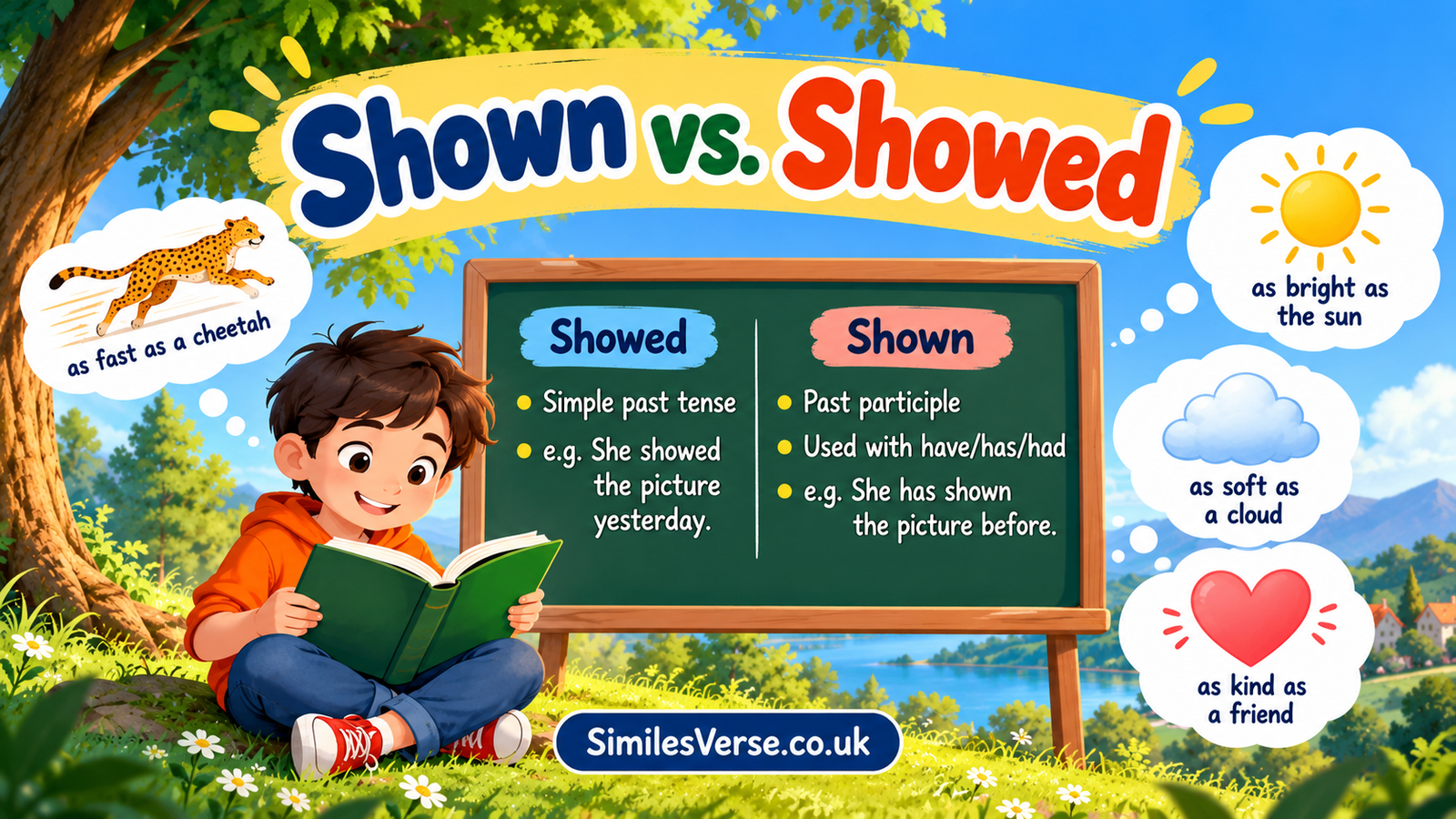
Shown and showed are both forms of the verb “show,” but they usually serve different grammatical purposes. “Showed” is the simple past tense, while “shown” is the preferred past participle in standard American English.
Compare these sentences:
- Showed: Olivia showed her family the photographs yesterday.
- Shown: Olivia has shown her family the photographs before.
- Shown: The photographs were shown during the reunion.
The first sentence uses the simple past tense. The second uses the present perfect tense, and the third uses the passive voice.
There’s one detail worth knowing: Merriam-Webster and Oxford also recognize “showed” as an alternative past participle. However, “shown” is the usual and recommended choice for academic, professional, and other carefully edited writing.
Shown vs. Showed: Quick Comparison
| Feature | Showed | Shown |
|---|---|---|
| Main grammatical role | Simple past tense | Past participle |
| Typical structure | Subject + showed | Have/has/had + shown |
| Simple past example | Emma showed the receipt. | Not used as the ordinary simple past |
| Present perfect example | Uncommon alternative | Emma has shown the receipt. |
| Passive voice | Uncommon as a participle | The receipt was shown. |
| Formal writing recommendation | Use for simple past | Use for perfect and passive constructions |
The easiest distinction: Use “showed” when describing an action or situation in the simple past. Use “shown” as the past participle in ordinary perfect-tense and passive-voice constructions.
What Are the Verb Forms of Show?
“Show” is an irregular verb. Although its simple past form follows the familiar -ed pattern, its usual past participle is different.
Here is its conjugation:
| Verb Form | Word | Example Sentence |
|---|---|---|
| Base form | Show | Please show me your notes. |
| Third-person singular present | Shows | The display shows the current temperature. |
| Present participle / -ing form | Showing | Marcus is showing us the new design. |
| Simple past | Showed | Marcus showed us the design yesterday. |
| Preferred past participle | Shown | Marcus has shown us the final design. |
The three principal forms commonly taught in English classes are:
Show → Showed → Shown
Unlike regular verbs such as “walk,” which commonly use “walked” for both the past tense and past participle, “show” normally uses two different forms.
This distinction becomes important when writing about previous events, experiences, presentations, evidence, or information.
When to Use Showed
“Showed” is the simple past tense of “show.”
Use it when describing something that happened or was true during a past period.
For example:
- The librarian showed us the reference section on Monday.
- My grandmother showed me how to sew when I was younger.
- The report showed a steady increase in attendance.
- The receptionist showed the visitors to the conference room.
In these sentences, “showed” is the main verb in the simple past tense.
Showed Can Describe Different Types of Past Events
The simple past does not mean an event happened only once.
It can describe a single action, repeated behavior, an extended period, or a past situation.
A single past action
Daniel showed the officer his identification at the entrance.
This describes a particular past event.
Repeated past actions
Every Friday, the instructor showed the class a short documentary.
The simple past describes an activity that happened repeatedly.
An extended past situation
Throughout the summer, the shop showed paintings by local artists.
Here, “showed” refers to an exhibition that continued over a period.
Evidence or information in the past
The survey showed that most participants preferred the earlier schedule.
The verb describes what the survey indicated.
Common Meanings of Showed
The verb can mean more than displaying something physically.
It can describe:
- Displaying: “The clerk showed the customer several jackets.”
- Demonstrating: “The coach showed the players a new passing technique.”
- Revealing: “The records showed several missing payments.”
- Expressing feelings: “He showed genuine concern for his neighbor.”
- Providing evidence: “The experiment showed a clear difference.”
- Guiding: “A volunteer showed us to our seats.”
The grammatical form remains “showed” because these are simple-past statements.
What About Did Show?
In simple-past questions and negatives, use did + show, not “did + showed.”
Correct:
- Did she show you the invitation?
- He did not show his ticket.
- I did show you the instructions!
Incorrect:
- Did she showed you the invitation?
- He did not showed his ticket.
The helping verb “did” already marks the past tense, so the main verb returns to its base form.
When to Use Shown
“Shown” is the preferred past participle of “show.”
A past participle is a verb form used in several grammatical structures, particularly perfect tenses and passive voice. It can also help describe nouns.
Here are four common uses.
1. Shown in Perfect Tenses
Perfect constructions generally combine a form of “have” with a past participle.
Examples:
- I have shown the proposal to three colleagues.
- Amelia has shown considerable improvement in math.
- We had shown the plans to the architect earlier.
In these sentences, “shown” works with “have,” “has,” or “had.”
2. Shown in Passive Voice
The passive voice is useful when the subject receives the action rather than performs it.
For example:
The safety instructions were shown to every passenger.
The instructions received the action of being displayed.
Other examples include:
- The apartment was shown to several prospective tenants.
- The final scores are shown on the website.
- The prototype will be shown at the conference.
Notice that “shown” stays the same while the helping verbs change.
3. Shown in Descriptions of Nouns
“Shown” can follow a noun and provide identifying information.
For example:
The prices shown on the menu include tax.
The phrase “shown on the menu” describes “prices.”
This usage is especially common in instructions, reports, and educational writing.
4. Shown in Adjective-Like Constructions
Past participles sometimes function in an adjective-like way.
For example:
The previously shown examples are still relevant.
Here, “previously shown” describes the examples.
This is another reason the rule “shown always needs a helping verb immediately before it” is too restrictive.
How to Use Shown in Perfect Tenses
Perfect tenses combine time relationships with the past participle.
Present Perfect: Has Shown or Have Shown
Structure: Subject + has/have + shown
Examples:
- The company has shown steady improvement this year.
- We have shown the apartment to several buyers.
- My sister has shown an interest in photography lately.
The present perfect connects an earlier event, experience, or situation to the present. It can also refer to something that continues up to now.
Compare:
- “She showed me the contract on Tuesday.” — The simple past places the event at a specified past time.
- “She has shown me the contract.” — The present perfect refers to the earlier event in relation to the present.
For a school assignment or professional document, “has shown” and “have shown” are the preferred forms.
Past Perfect: Had Shown
Structure: Subject + had + shown
Example:
The instructor had shown us the correct procedure before the examination began.
Two past events are involved. The instruction happened before the examination started.
Another example:
By the time we arrived, the agent had already shown the house to another family.
The past perfect identifies the earlier of two past events.
Future Perfect: Will Have Shown
Structure: Subject + will have + shown
Example:
By Friday afternoon, the trainer will have shown the software to every department.
This describes an action expected to be finished before a specified point in the future.
Another example:
By the end of the semester, our teacher will have shown us several ways to solve the problem.
The word “shown” is appropriate because it follows “will have” in a future-perfect construction.
Does Every Helping Verb Require Shown?
No. The main verb form depends on the grammatical structure, not merely on whether a helping verb appears.
Compare these sentences:
| Construction | Correct Sentence | Explanation |
|---|---|---|
| Future simple | She will show the chart tomorrow. | Will + base verb |
| Present progressive | She is showing the chart now. | Be + -ing form |
| Present perfect | She has shown the chart already. | Have/has + past participle |
| Simple past passive | The chart was shown yesterday. | Was/were + past participle |
| Past perfect passive | The chart had been shown earlier. | Had been + past participle |
All five sentences contain helping verbs, but they do not use the same form of “show.”
For example, “She will shown the chart” is incorrect. After the modal verb “will,” the main verb takes its base form: “show.”
Similarly, “She is shown us the chart” does not express the intended progressive action. The correct sentence is “She is showing us the chart.”
Remember the structures instead of relying on the presence of a helping verb.
Shown vs. Showed in Passive Voice
Passive voice changes the focus of a sentence.
In an active sentence, the subject performs the action.
In a passive sentence, the subject receives the action.
Example 1: A Classroom Presentation
Active: The instructor showed the class a new diagram.
Passive: A new diagram was shown to the class by the instructor.
Both sentences describe the same event.
The active sentence emphasizes the instructor. The passive sentence emphasizes the diagram.
Example 2: A Business Report
Active: The analyst showed the findings to the committee.
Passive: The findings were shown to the committee by the analyst.
The passive sentence uses “were shown” because “findings” is plural and the event happened in the past.
Present Passive vs. Past Passive
| Time | Example |
|---|---|
| Present | The instructions are shown on the opening screen. |
| Past | The instructions were shown during yesterday’s training. |
| Future | The instructions will be shown before the demonstration. |
| Present perfect | The instructions have been shown to every employee. |
“Shown” remains the past participle in these standard passive constructions.
Not every sentence with “was” or “were” is passive, however.
Compare:
- “She was showing the presentation.” — Past progressive, active voice.
- “The presentation was shown.” — Simple past, passive voice.
In the first sentence, the subject performs the action. In the second, the subject receives it.
Can Shown Be Used Without a Helping Verb?
Yes. A past participle can appear in a phrase that modifies a noun, even without a visible helping verb immediately before it.
Consider:
The results shown below support the conclusion.
The phrase “shown below” describes “results.”
We can express a similar meaning with a fuller relative clause:
The results that are shown below support the conclusion.
The shorter version is often described as a reduced relative clause.
Other examples:
- The photographs shown in the exhibit belong to local families.
- The choices shown on the registration page are available to new students.
- The evidence shown in the recording helped clarify the timeline.
In each sentence, “shown” describes a noun.
This construction is particularly useful in reports, captions, tables, and instructions.
Can Showed Be a Past Participle?
Yes. Although “shown” is the usual form, some authoritative dictionaries recognize “showed” as an alternative past participle.
Merriam-Webster lists both “shown” and “showed.” Oxford Advanced Learner’s Dictionary also lists both forms and notes that the use of “showed” as a past participle is rare.
Cambridge presents “shown” as the standard past participle in its American English entry.
That distinction matters because dictionary recognition and editorial preference are not identical.
Which Form Should You Actually Use?
Compare:
Preferred in edited American English:
I have shown you the updated schedule.
Dictionary-recognized but uncommon alternative:
I have showed you the updated schedule.
The second construction is not an invented verb form or one that every dictionary rejects. Nevertheless, the first is a better choice for most school assignments, professional emails, academic papers, and formal publications.
The same preference applies to:
- Has shown rather than has showed.
- Have shown rather than have showed.
- Had shown rather than had showed.
- Was shown rather than was showed.
Practical recommendation: Learn “show → showed → shown” as the normal pattern. Recognize the less common alternative when you encounter it, but use “shown” as the participle in polished American English.
Shown vs. Showed: 24 Example Sentences
These original examples demonstrate both forms in everyday situations.
School and Education
- The substitute teacher showed the class where to submit assignments.
- Our principal has shown strong support for the reading program.
- The science project was shown at the district exhibition.
“Showed” describes a past event, “has shown” uses the present perfect, and “was shown” is passive.
Work and Business
- The supervisor showed the new employee how to submit an expense report.
- The sales team has shown improvement since the new training began.
- The revised contract was shown to the legal department.
The last two examples use a past participle, while the first uses the simple past.
Technology and Screens
- The mobile app showed an error message after the update.
- The dashboard has shown the same warning all morning.
- The available storage options are shown on the settings page.
The third sentence uses the present passive, even though “shown” is a past participle.
Presentations and Reports
- The researcher showed the audience a summary of the findings.
- The quarterly reports have shown similar patterns.
- The percentages shown in the table are rounded.
The third sentence demonstrates a participial modifier rather than a perfect tense.
Everyday Conversation
- My neighbor showed me a shortcut through the park.
- You have shown remarkable kindness to our family.
- The route was shown to us on a printed map.
The choice depends on whether the sentence uses the simple past, present perfect, or passive voice.
Photos, Videos, and Documents
- Sofia showed her vacation pictures to her cousins.
- The editor has shown us the revised video.
- The documents were shown during the hearing.
The first sentence is active and simple past. The other two use “shown” as a past participle.
Feelings and Behavior
- The volunteers showed patience throughout the long event.
- The team has shown enthusiasm for the community project.
- Genuine appreciation was shown through their thoughtful letters.
“Show” can express emotions, attitudes, and behavior as well as the act of displaying something.
Passive Voice
- The artwork was shown at a regional gallery.
- The award winners were shown on the auditorium screen.
- The revised guidelines will be shown to the staff tomorrow.
All three sentences use passive constructions, with different time references.
Shown vs. Showed: Side-by-Side Examples
| Situation | Showed Example | Shown Example | Explanation |
|---|---|---|---|
| Sharing a photo | Mia showed me the picture yesterday. | Mia has shown me the picture before. | Simple past vs. present perfect |
| Demonstrating a skill | The chef showed us how to shape the dough. | The chef has shown that method several times. | Specific past demonstration vs. earlier experience |
| Presenting a report | Aaron showed the report to his manager. | The report was shown to the manager. | Active vs. passive |
| Displaying data | The screen showed last month’s totals. | The totals are shown on the screen. | Past statement vs. present passive |
| Showing evidence | The witness showed the investigator a receipt. | The receipt was shown during the interview. | Active vs. passive |
| Explaining instructions | The coach showed everyone the next exercise. | The exercise has been shown to every participant. | Simple past vs. present perfect passive |
The meanings are similar within each row, but the grammatical structures differ. “Shown” is not simply a more formal replacement for every occurrence of “showed.”
Common Mistakes With Shown and Showed
Some mistakes involve the wrong verb form. Others involve a form that dictionaries accept but editors usually avoid.
| Sentence to Review | Preferred Correction | Explanation |
|---|---|---|
| He shown me the report yesterday. | He showed me the report yesterday. | The ordinary simple past is “showed.” |
| I have showed the report. | I have shown the report. | “Shown” is preferred for the present perfect. |
| The photographs were show to the class. | The photographs were shown to the class. | Passive voice uses a past participle. |
| The instructor will shown the process. | The instructor will show the process. | “Will” takes the base form. |
| The instructor is shown us the process. | The instructor is showing us the process. | Progressive aspect uses the -ing form. |
| Did you showed him the instructions? | Did you show him the instructions? | “Did” takes the base form. |
| She has showing the project to visitors. | She has shown the project to visitors. | The present perfect uses a past participle. |
The second example deserves special attention. “Have showed” is a documented alternative, so it is more precise to call it nonpreferred in formal edited American English rather than universally impossible.
Shown vs. Showing vs. Showed
“Showing” is the -ing form of “show.”
It is different from both “showed” and “shown.”
| Word | Common Use | Example |
|---|---|---|
| Showed | Simple past | He showed the diagram yesterday. |
| Shown | Past participle | He has shown the diagram before. |
| Showing | Progressive verb form | He is showing the diagram now. |
| Shown | Passive voice | The diagram is shown on the screen. |
“Showing” does not necessarily indicate present time.
For example:
The engineer was showing the equipment to visitors yesterday.
This is the past progressive. The activity was in progress at a particular time in the past.
Compare it with:
The engineer showed the equipment to visitors yesterday.
The simple past presents the past activity as an event without emphasizing its ongoing nature.
Both sentences are grammatically correct, but they present the action differently.
Easy Ways to Remember Shown vs. Showed
The most reliable memory aid is:
Show → Showed → Shown
- Show: Base form — “I will show you.”
- Showed: Simple past — “I showed you yesterday.”
- Shown: Preferred past participle — “I have shown you before.”
A second useful reminder concerns sentence structure:
Has / have / had + shown
Is / are / was / were + shown when the construction is passive.
Will + show
Is / are / was / were + showing when the construction is progressive.
These patterns are more dependable than simply looking for a helping verb.
Practice Quiz: Shown or Showed?
Test your understanding with these 14 questions. When alternatives are possible in dictionaries, choose the form preferred in edited American English.
Questions
1. Choose the correct simple past form.
Yesterday, Nora _____ us the route to the library.
a) showed
b) shown
2. Choose the preferred form in formal writing.
The laboratory has _____ impressive progress.
a) showed
b) shown
3. Complete the sentence.
Last fall, the museum _____ historical maps every weekend.
a) showed
b) shown
4. Identify the passive sentence.
a) The manager showed the figures.
b) The figures were shown to the manager.
5. Choose the correct future form.
She will _____ the results on Monday.
a) show
b) showed
c) shown
6. Complete the negative sentence.
I did not _____ the receipt to the cashier.
a) show
b) showed
c) shown
7. Choose the preferred past perfect form.
By noon, he had _____ the demonstration to all four groups.
a) showed
b) shown
8. Change this sentence into passive voice.
The guide showed the visitors the map.
9. Choose the correct progressive form.
She is _____ the class how to operate the camera.
a) shown
b) showing
10. Choose the preferred passive construction.
The photographs _____ on the museum website.
a) are shown
b) are showed
11. Which sentence uses the present perfect?
a) They showed the plans yesterday.
b) They have shown the plans to the director.
12. Identify the noun modified by “shown.”
The fees shown on the enrollment page include materials.
What noun does “shown on the enrollment page” describe?
13. Correct the sentence.
He shown me the new schedule yesterday.
14. Complete the past progressive sentence.
She was _____ the students the new method when the bell rang.
a) show
b) showed
c) showing
d) shown
Answer Key
| Question | Answer | Explanation |
|---|---|---|
| 1 | a) showed | “Yesterday” places the event in the simple past. |
| 2 | b) shown | Preferred past participle after “has.” |
| 3 | a) showed | The simple past can describe repeated past events. |
| 4 | b | “Were shown” is a passive construction. |
| 5 | a) show | “Will” takes the base verb. |
| 6 | a) show | “Did not” takes the base verb. |
| 7 | b) shown | Preferred past participle after “had.” |
| 8 | The map was shown to the visitors by the guide. | Passive voice uses “was shown.” |
| 9 | b) showing | Present progressive uses the -ing form. |
| 10 | a) are shown | Preferred present passive construction. |
| 11 | b | “Have shown” forms the present perfect. |
| 12 | Fees | “Shown on the enrollment page” modifies “fees.” |
| 13 | He showed me the new schedule yesterday. | The simple past is “showed.” |
| 14 | c) showing | “Was showing” is past progressive. |
If you missed a question, identify the sentence structure first: simple past, perfect tense, passive voice, or progressive aspect. That usually makes the correct form clearer.
Frequently Asked Questions
What is the difference between shown and showed?
“Showed” is the simple past form of “show.” “Shown” is its usual past participle, especially in perfect tenses, passive voice, and participial modifiers.
Is showed the past tense of show?
Yes. “Showed” is the standard simple past form. For example, “I showed my teacher the assignment yesterday.”
Is it I have shown or I have showed?
“I have shown” is the preferred form in standard edited American English. Some dictionaries also recognize “I have showed” as an uncommon alternative.
Is has showed ever correct?
Yes, as a dictionary-recognized alternative past participle construction. However, “has shown” is the recommended form for academic, business, and other formal writing.
Is was shown correct?
Yes. “Was shown” is a standard past passive construction, as in “The documentary was shown at the festival.”
Can I say he shown me?
Not as an ordinary simple-past statement in standard American English. Say “He showed me.”
You can say “He has shown me” when using the present perfect.
Can shown appear without a helping verb?
Yes. For example, “The values shown below are approximate.” Here, “shown below” modifies “values.”
What is the difference between shown and showing?
“Shown” is a past participle. “Showing” is the -ing form, commonly used in progressive constructions such as “is showing” and “was showing.”
Is it the results are shown or the results are showed?
“The results are shown” is the preferred construction in edited American English. It uses the present passive.
Which form should I use in academic writing?
Use “showed” for ordinary simple-past statements and “shown” as the past participle in perfect tenses, passive constructions, and participial modifiers.
Final Thoughts
The difference between “shown” and “showed” becomes easier to understand once you recognize their grammatical roles.
“Showed” is the simple past. “Shown” is the preferred past participle. “Showing” is the -ing form.
Remember the core pattern:
Show → Showed → Shown
Some dictionaries recognize “showed” as an alternative past participle, but using “shown” in perfect and passive constructions is the safest choice for clear, professional American English.
Instead of choosing a verb form based on a single nearby word, examine the full sentence structure. That approach will help you use these forms correctly in conversations, assignments, emails, and reports.
