


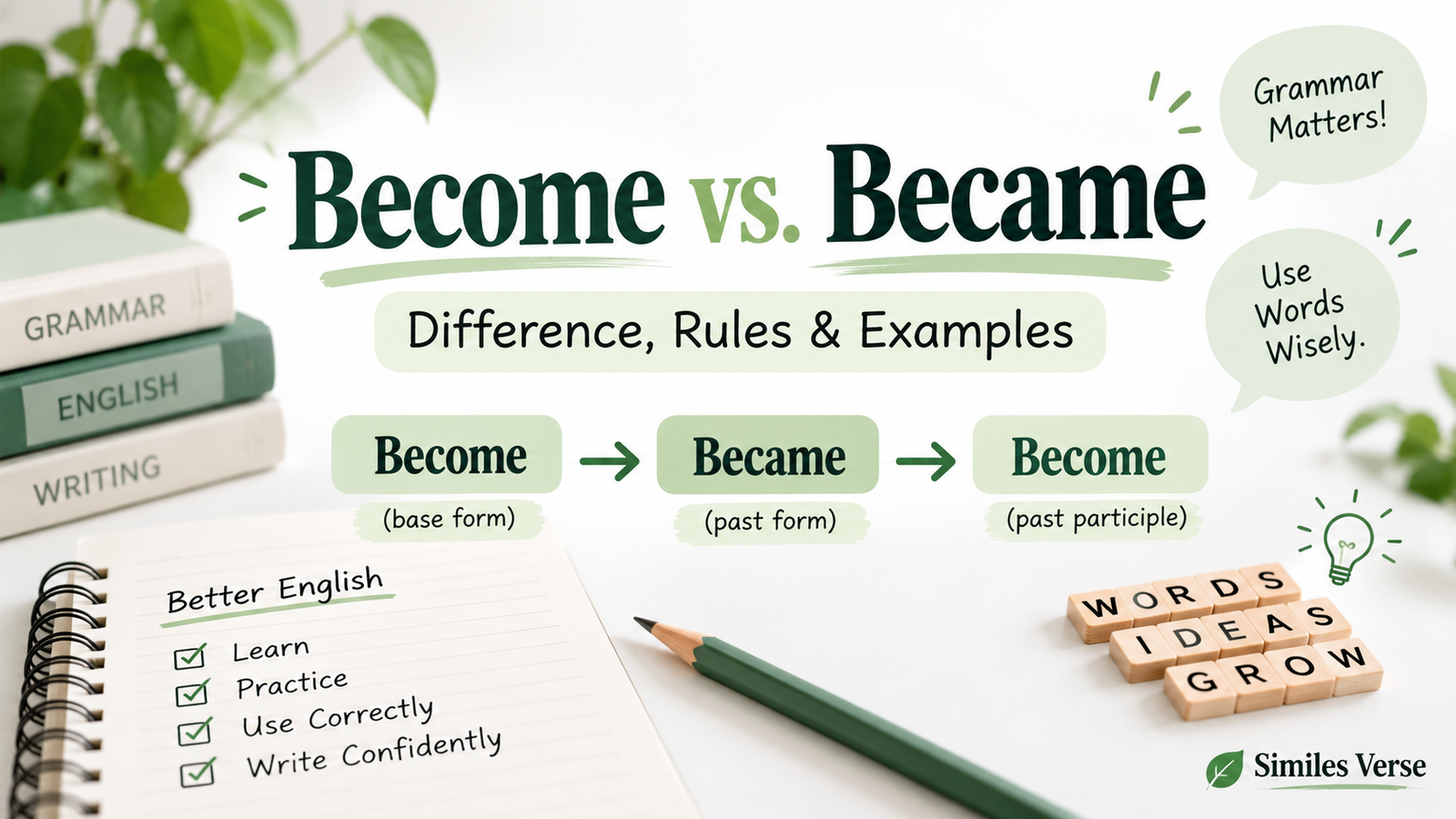
Become is the base form and past participle of the irregular verb become, while became is its simple past tense. The correct choice depends on the grammar of your sentence, not just whether you are talking about the present or the past.
Compare these three sentences:
- I want to become a teacher. — Become follows the infinitive marker to.
- I became a teacher last year. — Became describes a change in the past.
- I have become more confident. — Become is the past participle used with have.
The easiest way to remember the verb forms is:
Become → Became → Become
This guide explains how to use each form correctly in statements, questions, negative sentences, and different verb tenses.
Become, Became, and Becoming: Verb Forms
Become is an irregular verb. Its past tense does not end in -ed, and its base form and past participle are identical.
| Verb form | Correct word | Example sentence | Grammar function |
|---|---|---|---|
| Base form | Become | I hope to become a nurse. | Used after to, modals, and certain auxiliaries |
| Third-person singular | Becomes | He becomes quiet when he reads. | Simple present with he, she, it, or a singular noun |
| Present participle | Becoming | The sky is becoming darker. | Used in progressive constructions |
| Simple past | Became | The sky became dark before the storm. | Describes a past change |
| Past participle | Become | The town has become popular. | Used in perfect constructions |
The verb forms follow the pattern become, became, become, much like come, came, come.
In the simple present, I become, you become, we become, and they become are grammatical when the context describes a habit, repeated change, or general pattern. For example, “I become nervous before interviews” describes something that regularly happens.
What Does Become Mean?
Become generally means to begin to be something or to change into a particular condition, role, or state.
It can be followed by a noun phrase or an adjective:
- Become a parent — begin to have the role of a parent.
- Become famous — reach a state of being famous.
- Become anxious — begin to feel anxious.
- Become a problem — develop into a problem.
The change can be gradual or sudden. Someone may become skilled over several years, while another person may become frightened in an instant.
When to Use Become
The base form appears in several common sentence structures.
1. Simple present
Use become with I, you, we, they, and plural nouns when describing repeated situations or general facts.
People become more comfortable with new routines through experience.
This is a general observation rather than a statement about one particular past event.
2. Infinitive: To become
Use to become after verbs and expressions that require an infinitive.
Lena wants to become a veterinarian.
The verb wants expresses Lena’s wish, while to become identifies her goal.
3. Future: Will become
Use the base form after will.
The new policy will become effective in January.
Even though the sentence refers to the future, the correct form is become.
4. Modal verbs
Modal verbs such as can, could, may, might, should, and would are followed by the base form.
Without regular maintenance, the equipment could become unsafe.
5. Questions and negatives with Did
When did or didn’t carries the past tense, the main verb stays in its base form.
Did you become interested in science during high school?
6. Past participle in perfect tenses
Become is also used with forms of have.
The neighborhood has become noticeably quieter.
Although this sentence refers to a change that occurred before now, the correct verb form is still become.
What Does Became Mean?
Became is the simple past tense of become. It places a change or transition in a past time frame.
Examples:
- Education: Marcus became a stronger reader during fifth grade.
- Career: Olivia became the store manager in April.
- Emotions: The audience became excited when the band appeared.
- Weather: The afternoon became unusually humid.
- Relationships: Two former rivals became close friends.
- Confidence: Mateo became less nervous after his first presentation.
- Business: The small bakery became a neighborhood favorite.
- Everyday changes: The screen became brighter after the update.
You can use became with a definite past-time expression such as yesterday, last month, in 2022, or two hours ago.
For example:
The hallway became silent when the principal entered.
The change happened at a particular moment in the past.
Does Became Mean the Situation Has Ended?
No. Became tells us when the change occurred, but it does not automatically tell us whether the resulting condition continues.
Consider:
She became a teacher in 2020 and still teaches today.
This sentence is grammatically correct. Her transition into teaching happened in 2020, and her career continues.
Similarly, someone who became a citizen years ago may still be a citizen today.
Can Became Describe a Sudden Change?
Yes.
The child became frightened when the alarm sounded.
The change happened suddenly. The verb become does not require a long transformation.
Become vs. Became: Comparison Table
These examples show how different grammatical constructions affect the correct word choice.
| Situation | Become example | Became example | Explanation |
|---|---|---|---|
| Career | I hope to become a paramedic. | I became a paramedic in 2021. | Infinitive versus simple past |
| Feelings | Crowds can become impatient. | The crowd became impatient after the delay. | Modal construction versus past event |
| Weather | Roads become icy in winter. | The roads became icy overnight. | General pattern versus specific past change |
| Education | Students become better readers with practice. | Nora became a confident reader last semester. | General development versus past development |
| Relationships | Neighbors often become friends. | We became friends during orientation. | Repeated pattern versus past event |
| Conditions | The process might become difficult. | The process became difficult after the changes. | Possibility versus past change |
| Personal growth | You become more capable through experience. | He became more independent in college. | General statement versus past transition |
The important difference is grammatical structure. Become is not limited to present time, and became does not mean that the outcome no longer exists.
Has Become or Has Became?
Has become is correct. Has became is incorrect in standard American English.
The present perfect follows this structure:
Has + past participle
The past participle of become is become, not became.
Correct: She has become more confident at work.
Incorrect: She has became more confident at work.
The present perfect often describes a development that is relevant to the present.
The restaurant has become popular with local families.
This focuses on its development and present relevance. It does not require the process of becoming popular to still be happening.
Have Become or Have Became?
Have become is the correct present-perfect construction.
Correct: They have become good friends.
Incorrect: They have became good friends.
Use have become with I, you, we, and they. Use has become with he, she, it, and most singular noun subjects.
| Subject | Correct form |
|---|---|
| I | I have become |
| You | You have become |
| We | We have become |
| They | They have become |
| He | He has become |
| She | She has become |
| It | It has become |
For example:
I have become more organized since starting my new job.
You have become much more comfortable speaking in public.
The instructions have become easier to follow.
Remember that have is not restricted to plural subjects. Both I and you use have.
Had Become or Had Became?
Had become is correct because the past perfect uses had followed by the past participle.
Had + become
Correct: The city had become crowded before the festival began.
Incorrect: The city had became crowded before the festival began.
The past perfect is useful when referring to a change that occurred before another past event or reference point.
By the time the guests arrived, the living room had become warm.
The living room was already warm when the guests arrived.
Another example:
She had become interested in architecture before she applied to college.
Her interest developed before the application.
Will Have Become: Future Perfect
The future perfect uses the structure:
Will have + past participle
With this verb, the correct form is will have become.
By next summer, Daniel will have become a certified instructor.
This means Daniel is expected to achieve that status by a particular future point.
Another example:
By the end of the course, the students will have become familiar with the software.
The future perfect is useful when the timing of a completed transition matters. In ordinary conversation, will become is often simpler.
Did Become or Did Became?
Did become is correct. Did became is incorrect.
The auxiliary did already expresses past tense, so the main verb uses its base form.
Questions with Did
Correct: Did she become the team captain?
Incorrect: Did she became the team captain?
Other examples:
- Did the discussion become more serious?
- When did you become interested in photography?
- Did the company become profitable last year?
Negative Sentences with Didn’t
Correct: She did not become the team captain.
Incorrect: She did not became the team captain.
You can also use the contraction didn’t:
We didn’t become friends until our second year of college.
Emphatic Statements with Did Become
In an ordinary affirmative past-tense statement, use became.
He became more confident after the workshop.
However, did become is also grammatical when emphasizing that the change really happened.
He did become more confident, despite his initial doubts.
Both sentences refer to the past, but the second adds emphasis.
Will Become or Will Became?
The correct construction is will become.
Correct: She will become a doctor after completing her training.
Incorrect: She will became a doctor after completing her training.
The rule is:
Will + base verb
The same base-form rule applies to common modal verbs.
| Modal | Correct example |
|---|---|
| Can | Regular exercise can become a healthy habit. |
| Could | The delay could become a serious problem. |
| May | The new approach may become standard practice. |
| Might | The forecast might become less reliable. |
| Should | The instructions should become clearer after revision. |
| Would | The garden would become greener with more water. |
Do not place became directly after these modals in ordinary constructions.
Would Become in Conditional Sentences
If Ava practiced more regularly, she would become a stronger pianist.
This describes a hypothetical result.
For a realistic future possibility, you might say:
If Ava practices regularly, she will become a stronger pianist.
Both sentences use become after their respective modal verbs.
Become vs. Becomes: Subject-Verb Agreement
In the simple present, the form depends on the subject.
Use becomes with he, she, it, and third-person singular noun subjects.
Use become with I, you, we, they, and plural noun subjects.
Examples:
- He becomes nervous before important meetings.
- She becomes excited whenever her cousins visit.
- It becomes colder after sunset.
- They become restless during long delays.
- I become tired after a difficult workout.
- You become more confident with experience.
Even when you refers to just one person, the simple-present form is still become.
Compare:
He becomes frustrated when the internet is slow.
His coworkers become frustrated when the internet is slow.
The first subject is third-person singular; the second is plural.
After a modal, however, use the base form even with a third-person singular subject:
She can become a skilled editor.
Not: She can becomes a skilled editor.
Become vs. Becoming
Become is the base form. Becoming is the present participle, or -ing form.
Use becoming with forms of be to describe a change in progress.
Compare:
The employees become impatient during lengthy meetings.
This describes a repeated pattern.
The employees are becoming impatient.
This describes a change developing now.
The employees were becoming impatient.
This describes a change that was developing at a past reference time.
Four Ways to Describe the Same Change
| Sentence | Meaning |
|---|---|
| The room becomes noisy after lunch. | A regular or repeated pattern |
| The room is becoming noisy. | A change in progress now |
| The room became noisy. | A change that happened in the past |
| The room has become noisy. | A change before now presented as relevant to the present |
The -ing form is not limited to present time. It can appear in past and future progressive constructions.
For example:
By the time I arrived, the discussion was becoming heated.
Became vs. Has Become: Simple Past and Present Perfect
Both constructions can describe changes, but they present those changes differently.
Simple past:
She became interested in astronomy last year.
This sentence locates her growing interest within a definite past period.
Present perfect:
She has become interested in astronomy recently.
This presents the development as relevant to the present without assigning it to a specific, finished past-time point.
Compare:
- The store became popular in 2019.
- The store has become popular in recent years.
The first identifies when the change happened. The second looks at the development from a present perspective.
In standard American English, a definite finished time such as in 2019 normally calls for the simple past in this kind of statement.
However, simple past does not mean a resulting condition has ended.
The examples below cover school, work, personal development, everyday situations, and questions.
School and Education
- Students become more independent as they learn to manage assignments.
- Priya became interested in chemistry during her first laboratory class.
- The reading assignments are becoming more challenging this semester.
Career and Work
- I hope to become a graphic designer after graduation.
- Carter became the department supervisor in March.
- Our team has become more efficient since adopting the new schedule.
Emotions and Personal Development
- People sometimes become anxious before major life changes.
- Elena became emotional when she heard the announcement.
- He is becoming more comfortable sharing his opinions.
Weather and Nature
- The sidewalks become slippery after freezing rain.
- The sky became orange as the sun disappeared behind the hills.
- The air had become cooler by the time we reached the campground.
Family and Relationships
- Siblings often become closer as they grow older.
- Their families became friends after moving into the same neighborhood.
- My grandparents have become more interested in learning about technology.
Everyday Situations
- A minor inconvenience can become a major problem if ignored.
- The soup became thick after simmering for another ten minutes.
- The apartment will become available at the beginning of next month.
Questions and Negatives
- Did the instructions become clearer after the demonstration?
- Why did the traffic become so heavy yesterday?
- The conversation did not become uncomfortable until the final question.
Perfect Tenses
- Several local businesses have become involved in the community project.
- By midnight, the roads had become difficult to navigate.
- By the final rehearsal, the actors will have become familiar with their roles.
Notice that the correct form changes with the sentence structure. A past-related sentence can contain become when it functions as a past participle or follows the auxiliary did.
Common Mistakes with Become and Became
These examples show incorrect forms in standard American English and how to correct them.
| Incorrect sentence | Correct sentence | Why it is correct |
|---|---|---|
| She has became famous. | She has become famous. | Has takes a past participle. |
| They have became friends. | They have become friends. | Have takes become. |
| He will became a doctor. | He will become a doctor. | Will takes the base form. |
| Did you became tired? | Did you become tired? | Did already marks past tense. |
| She become angry yesterday. | She became angry yesterday. | A specific past event uses became. |
| He become nervous every morning. | He becomes nervous every morning. | He takes becomes in the simple present. |
| The situation had became serious. | The situation had become serious. | Past perfect requires a past participle. |
| I want to became an engineer. | I want to become an engineer. | The infinitive is to become. |
| She is become more confident. | She is becoming more confident. | An ongoing change uses is becoming. |
| We didn’t became interested. | We didn’t become interested. | The main verb remains in the base form after didn’t. |
These corrections follow the intended tense or structure of each example. Some sentences could be expressed differently if the intended meaning or time frame changed.
Why Are Become and Became Often Confused?
The verb is irregular, and two of its principal forms look exactly alike.
Compare:
Come → Came → Come
Become → Became → Become
In both patterns, the first and third forms are identical, while the simple past form is different.
That is why has become may seem surprising: it uses the same spelling as the base form, even though its grammatical function is different.
An Easy Memory Trick
Become = base form or past participle.
Became = simple past.
Before choosing, check the word immediately before the verb.
If you see has, have, or had, you usually need the past participle become. If you see did, will, can, or might, you need the base form become. For a normal affirmative statement about a past event, became is often the correct choice.
Two Other Meanings Worth Knowing
Become usually describes a change, but it has other established uses.
That color becomes you.
Here, becomes means that the color suits you or makes you look attractive.
Whatever became of your old neighbor?
This expression asks what happened to someone or what their later circumstances were.
These uses are different from the main tense comparison, but the grammatical forms still follow the same conjugation pattern.
Practice Quiz: Become vs. Became
Choose the correct answer or complete the instruction. Try the questions before checking the answer key.
- Last October, Julia ___ a volunteer at the animal shelter. (become / became)
- Most beginners ___ more comfortable with practice. (become / became)
- She ___ a confident speaker. (has become / has became)
- We ___ close friends over the past few months. (have become / have became)
- By the time the show started, the theater ___ crowded. (had become / had became)
- ___ the job more demanding after the promotion? (Did it become / Did it became)
- He ___ interested in the course until the second week. (did not become / did not became)
- By next fall, the twins ___ teenagers. (will become / will became)
- With support, the plan ___ successful. (could become / could became)
- My sister ___ impatient when meetings run late. (become / becomes)
- The weather is ___ warmer this afternoon. (become / becoming)
- Complete the principal forms: become → ___ (simple past) → ___ (past participle).
- Correct this sentence: My friend has became interested in painting.
- Rewrite in the present perfect without the finished-time expression: Maya became more independent last year.
- Rewrite in the simple past using yesterday: The street has become quiet.
Practice Quiz Answers and Explanations
- Became. Last October places the event in the past.
- Become. The plural subject beginners takes become in the simple present.
- Has become. Present perfect uses has plus the past participle.
- Have become. The subject we takes have, followed by become.
- Had become. The theater was already crowded before the show started.
- Did it become. The main verb must be in its base form after did.
- Did not become. The negative past construction uses did not plus the base form.
- Will become. Future simple uses will plus the base form.
- Could become. Modal verbs take the base form.
- Becomes. My sister is a third-person singular subject.
- Becoming. The present progressive is formed with is plus the -ing form.
- Became; become. The principal forms are become, became, become.
- My friend has become interested in painting. Has requires the past participle become.
- Maya has become more independent. This is a model present-perfect answer. Other correct responses are possible, but the definite past-time phrase last year is removed.
- The street became quiet yesterday. This is a model simple-past answer. Became works with the specified past-time expression.
Frequently Asked Questions
What is the difference between become and became?
Become is the base form and past participle of the verb. Became is its simple past tense. For example, “I want to become a writer” and “I became a writer in 2022” use different grammatical forms.
Is became the past tense of become?
Yes. Became is the simple past tense of the irregular verb become.
What is the past participle of become?
The past participle is become. Its three principal forms are become, became, become.
Is “I became” grammatically correct?
Yes. “I became interested in art during high school” is a correct simple-past sentence.
Is “I have become” correct?
Yes. I have become is a correct present-perfect construction. For example, “I have become more patient.”
Is “I have became” correct?
No. Use “I have become” because have requires the past participle.
Should I write has become or has became?
Write has become. For example, “The project has become more complicated.”
Is it had become or had became?
Use had become. The past perfect follows had + past participle.
Is it did become or did became?
Use did become. The auxiliary did carries the past tense, so become stays in its base form.
Is it will become or will became?
Use will become. The verb after will must be in the base form.
When should I use becomes instead of become?
Use becomes with third-person singular subjects in the simple present, as in “She becomes nervous before exams.” Use become with subjects such as I, you, we, and they.
What is the difference between become and becoming?
Become is the base form, while becoming is the -ing form. For instance, “They may become friends” expresses a possibility, while “They are becoming friends” describes a developing relationship.
Can become describe a past event?
Yes. Become can refer to a past event as a past participle in “They had become friends,” or as a base form in “Did they become friends?”
How can I remember become, became, become?
Remember that the first and third forms are the same. Use became for the simple past and become for the base form or past participle.
Final Thoughts
Choosing between become and became is easier when you look at the complete verb phrase.
Use became for a normal simple-past statement. Use become after to, did, will, and modal verbs, and as the past participle after has, have, or had.
Remember the pattern:
BECOME → BECAME → BECOME
Once you recognize these three forms, you can use the verb accurately in everyday conversation, school assignments, and professional writing.
